
CPR Face Shield vs Pocket Mask: Which CPR Breathing Barrier Do You Need?
Published by UnityMedicalSupplies on Oct 26th 2026
Updated October 2026
The short answer
A CPR face shield is a thin, flat barrier that sits over the person's mouth while you give rescue breaths. It is cheap, tiny and easy to carry on a key ring, so it suits cars, homes, purses and most first aid kits. A CPR pocket mask is a rigid mask that seals over both the mouth and nose. It gives a better seal and more protection, but it is bulkier and works best in the hands of someone trained to use it.
For most people, a face shield in every kit and on every key ring is the practical choice. Workplaces with trained responders often add pocket masks. In either case, the barrier only helps if it is within reach.
What a CPR face shield is
A CPR face shield is a sheet of plastic with a mouthpiece in the center. You lay it over the person's face, line the mouthpiece up with their mouth and breathe through it. Most include a one-way valve or filter, so the person's exhaled air and fluids don't come back to you.
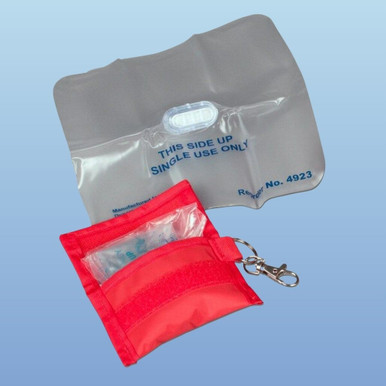
The Dynarex CPR Face Shield Unity carries is typical:
- One-way valve plus a filter barrier. Dynarex says this stops blowback and is designed to reduce cross-contamination and fluid transfer during rescue breathing.
- Pocket-size soft case with a swivel hook, so it clips to a belt loop, key ring or bag.
- Disposable, single shield per case.
- No natural rubber latex.
- Sold each, or 100 per case for workplaces, schools and kit builders.
Strengths: very low cost, fits anywhere, little skill needed. Limits: a thinner seal, and it covers the mouth only, so you pinch the nose closed while giving breaths.
What a CPR pocket mask is
A pocket mask (also called a CPR mask) is a rigid, clear mask with a soft rim. It sits over the person's face and seals around both the mouth and nose. You breathe into a port on top that has a one-way valve or a disposable filter. Many models also have an inlet for supplemental oxygen, as Wikipedia's overview notes. Masks usually come folded in a hard or soft case.
Strengths:
- A better seal than a flat shield.
- More distance between you and the person's face.
- You don't need to pinch the nose.
- The rescuer can use both hands to hold the seal and tilt the head.
- Many accept oxygen.
Limits:
- Bulkier and more expensive than a face shield.
- Getting a good seal takes practice, so pocket masks are most common among trained responders.
The First Aid Only 100-person, 683-piece first aid kit on Unity includes a CPR mask among its specialized tools.
CPR face shield vs pocket mask at a glance
| CPR face shield | CPR pocket mask | |
|---|---|---|
| What it covers | The mouth area; you pinch the nose | Mouth and nose, with a sealed rim |
| Protection | One-way valve and/or filter | One-way valve or filter, more distance from the face |
| Seal | Thinner; easier to leak | Better seal once you have practiced |
| Size | Fits on a key ring or in a pocket | Folded in a case; larger |
| Oxygen port | No | Often |
| Skill needed | Low | Moderate; training recommended |
| Typical use | Cars, homes, purses, personal and small kits | Workplace responders, lifeguards, clinics, larger kits |
| Cost | Lowest | Higher |
| On Unity | Dynarex CPR Face Shield, each or 100 per case | Included in the First Aid Only 683-piece kit |
Do you need a barrier at all? For an adult or teen who suddenly collapses, the American Heart Association teaches Hands-Only CPR: call 911 and push hard and fast in the center of the chest. No breaths and no barrier are needed. The AHA recommends CPR with breaths for:
- infants and children;
- drowning and drug overdose;
- people who collapse from breathing problems;
- prolonged cardiac arrest.
Those are the times a barrier earns its place.
Which barrier to keep where
- Car, purse, backpack, key ring: a face shield. It weighs almost nothing, so you will actually have it with you.
- Home first aid kit: a face shield at minimum. If anyone in the home has CPR training, a pocket mask is a good addition, especially with babies, young children or a pool in the picture.
- Workplace first aid kits: a face shield in every kit, and pocket masks for trained responders. OSHA's bloodborne pathogens standard (29 CFR 1910.1030(d)(3)(i)) says that where workers have occupational exposure, employers must provide personal protective equipment at no cost. Its list includes "mouthpieces, resuscitation bags, pocket masks, or other ventilation devices." See our guide to what to keep in a workplace first aid kit.
- Schools, coaches, camps, gyms: face shields by the case, so every kit and every coach's bag has one.
- Clinics and care facilities: follow your clinical protocol and equipment policy, which may call for pocket masks or bag-valve-mask devices.
Buying for many kits? The Dynarex face shield comes 100 to a case, and orders over $50 ship free. Pair it with one of our first aid kits and a box of nitrile exam gloves.
Care, storage and replacement
- Keep it in its case and in the same place every time: the kit's top pocket, the glove box, the key ring.
- Face shields are single-use. The Dynarex shield is disposable; replace it after any use, and if the case is torn or the shield looks damaged.
- Pocket masks follow the manufacturer's instructions for cleaning and for replacing the valve or filter after use.
- Check your kits on a schedule. When you restock gloves and bandages, confirm that every kit still has its barrier. Our workplace first aid kit guide includes a refill checklist.
- Get trained. A barrier is a small part of CPR. A hands-on class from the American Heart Association or the American Red Cross teaches compressions, breaths and how to use a barrier quickly.
Frequently asked questions
Is a CPR face shield as good as a pocket mask?
Not quite. A pocket mask seals over the mouth and nose and gives a better seal and more distance from the person's face. A face shield is far easier to carry, though, and the best barrier is the one you have with you. Many people carry a shield and keep a mask in larger kits.
Do I need a barrier to do CPR?
Not for Hands-Only CPR on an adult or teen who suddenly collapses: the AHA's two steps are to call 911 and push hard and fast in the center of the chest. A barrier matters when you give rescue breaths, which the AHA recommends for infants and children, drowning, overdose, breathing problems and prolonged arrest.
What does the one-way valve do?
It lets your breath pass into the person while stopping their exhaled air and fluids from coming back to you. The Dynarex face shield combines a one-way valve with a filter barrier.
Can a CPR face shield be reused?
No. Disposable face shields such as the Dynarex shield are made for one use. Replace it after use and restock the kit.
Does OSHA require CPR masks in workplace first aid kits?
OSHA's bloodborne pathogens standard requires employers to provide appropriate protective equipment, including ventilation devices such as pocket masks, where workers have occupational exposure. Exactly what your workplace needs depends on its exposure determination and first aid program, so check with your safety lead.
Shop the Dynarex CPR Face Shield, single or 100 per case, and our first aid kits. Orders over $50 ship free.