
Wound Cleanser vs Saline: What to Use to Clean a Wound at Home
Published by UnityMedicalSupplies on Oct 26th 2026
Updated October 2026
The short answer
For most minor cuts and scrapes, clean running water is enough to rinse the wound, with mild soap on the skin around it. Sterile saline is the gentle choice when you want a sterile rinse or are away from a tap. A no-rinse wound cleanser spray is built for repeat dressing changes: it adds surfactants that lift debris, and an antiseptic version adds protection against bacterial contamination.
What matters most is not the bottle you pick. It is rinsing well, keeping harsh products out of the wound, and covering it with a clean dressing.
This guide compares saline and wound cleansers, explains what each does, and walks through a simple routine for cleaning a wound at home. It covers everyday minor wounds. Deep, dirty, bite or surgical wounds need advice from a clinician.
What is saline wound wash?
Saline wound wash is sterile salt water: 0.9% sodium chloride, often called normal saline. It has roughly the same salt balance as body fluids, so it rinses a wound without stinging. Pharmacy versions come in pressurized cans or squeeze bottles that spray a steady stream.
Saline does one job: it flushes away dirt, blood and loose debris. It contains no soap and no antiseptic, so it doesn't break down stuck-on crust or kill germs.
Is saline better than tap water? Not clearly. A 2022 Cochrane review of 13 trials found no clear difference in infection rates between wounds cleaned with tap water and wounds cleaned with saline. The evidence was low certainty, so neither option has been proven better. For a minor cut at home, Mayo Clinic advises rinsing under running water.
When saline makes sense:
- You are away from clean running water: in the car, outdoors or at a sports field.
- You want a sterile rinse in a single-use or travel-size container.
- A clinician has told you to use sterile saline, which is common after surgery.
Once a saline container is opened it is no longer sterile, so follow the storage directions on its label.
Homemade salt water is not sterile. Don't use it on deep or surgical wounds.
What is a wound cleanser?
A wound cleanser is a ready-to-use spray made for repeated cleaning of skin wounds. Unlike plain saline, it contains surfactants (gentle cleaning agents) that help loosen debris and dried drainage. Some also contain an antiseptic. Most come in a trigger bottle that sprays a mist or a stream, so you can rinse without touching the wound.
Caregivers and clinics often reach for a wound cleanser at dressing changes, when the same wound is cleaned again and again.
Unity carries two:
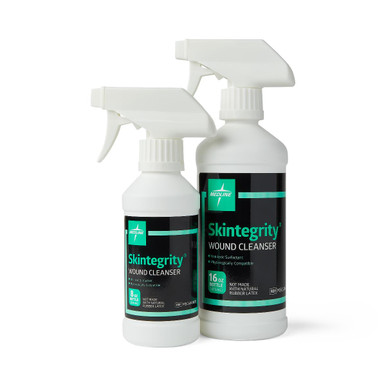
- Medline Skintegrity Wound Cleanser is a gentle, noncytotoxic cleanser, meaning it is formulated not to harm healthy cells. A nonionic surfactant helps lift protein and debris. The trigger sprays a mist or a stream, at 8.6 PSI from 3 inches, which is within the range considered optimal for wound irrigation. It comes in 8 oz and 16 oz bottles, 6 per case, and is formulated for wounds in all stages.
- Medline MicroKlenz Antiseptic Wound Cleanser is a no-rinse antiseptic spray for minor cuts, scrapes and burns. Its active ingredient, benzethonium chloride, is designed to help reduce the chance of bacterial contamination. Wetting agents help lift debris, and you can go straight to the dressing without rinsing. It comes in 8 oz spray bottles, 6 per case.
Both are listed in our wound cleansers category.
Wound cleanser vs saline vs tap water at a glance
| Clean running water | Sterile saline wound wash | Gentle wound cleanser (Skintegrity) | Antiseptic wound cleanser (MicroKlenz) | |
|---|---|---|---|---|
| What it is | Drinking-quality tap water | 0.9% sodium chloride, sterile until opened | Noncytotoxic spray with a nonionic surfactant | No-rinse spray with benzethonium chloride |
| Lifts stuck-on debris | Rinses only | Rinses only | Yes, surfactant helps loosen it | Yes, wetting agents and surfactants |
| Antiseptic | No | No | No | Yes |
| Rinse afterward | No | No | Follow the label | No |
| Best for | Fresh minor cuts and scrapes at home | Rinsing away from a tap; when a clinician asks for sterile saline | Repeat cleaning at dressing changes | Minor cuts, scrapes and burns where you want an antiseptic step |
| Where to get it | At home | Pharmacies | Unity, 8 or 16 oz, 6 per case | Unity, 8 oz, 6 per case |
Saline and wound wash are often the same thing: most products sold as "wound wash" are sterile saline in a spray can. A product called a "wound cleanser" usually adds cleaning agents, an antiseptic, or both, so read the label to see which you have.
How to clean a minor wound at home, step by step
These steps follow first-aid guidance from Mayo Clinic and the American College of Surgeons. If a clinician gave you instructions for a specific wound, follow theirs.
- Wash your hands. Use soap and water, or an alcohol-based hand gel if your hands aren't visibly dirty. Put on disposable gloves such as nitrile exam gloves if you are caring for someone else.
- Stop the bleeding. Press gently with clean gauze and raise the area if you can. Most minor cuts stop on their own.
- Rinse the wound. Hold it under clean running water, or spray it with saline or a wound cleanser. Keep going until you no longer see dirt.
- Wash around it. Use mild soap on the skin around the wound, then rinse until no soap remains. Keep soap out of the wound itself.
- Remove leftover debris. Use tweezers cleaned with alcohol, or a cotton-tipped applicator for crust and blood. If debris won't come out, see a clinician. Our guide to using swabs to clean wounds covers swab technique.
- Pat the skin dry. Pat the surrounding skin dry with clean gauze.
- Keep the wound moist. A thin layer of an ointment such as triple antibiotic ointment or petroleum jelly keeps the surface moist. Stop if a rash appears.
- Cover it. Use an adhesive bandage, or a non-adherent pad held with paper tape. Not sure which? See gauze pads vs non-stick dressings.
- Repeat daily. Change the dressing at least once a day, or sooner if it gets wet or dirty, and clean the wound the same way each time.
A wound cleanser earns its place at step 9. When a wound needs cleaning every day for weeks, a spray bottle is faster and easier to control, and nobody has to move a bedbound person to a sink.
What not to clean a wound with
The American College of Surgeons advises against using disinfectants and antiseptics like these to clean open wounds, because they are more likely to damage tissue than to help it heal:
- Hydrogen peroxide. The fizzing does not mean it's helping. Mayo Clinic notes it can irritate wounds.
- Rubbing alcohol. Keep alcohol for cleaning tweezers, not the wound itself.
- Iodine. It can also irritate the wound.
- Soap inside the wound. Wash around the wound, not in it.
- Products not made for wounds. Stick to clean water, saline or a product labeled for wound care.
A purpose-made antiseptic wound cleanser such as MicroKlenz is a different case: it is formulated and labeled for use on minor cuts, scrapes and burns. Use any wound product as its label directs.
How to choose
- A fresh scrape or small cut at home: rinse under clean running water. You don't need to buy anything.
- First aid kit for the car, a job site or sports: pack a saline wound wash or a no-rinse antiseptic spray like MicroKlenz, since there may be no tap nearby. Our first aid kits pair well with one.
- Daily dressing changes for someone you care for: a gentle wound cleanser like Skintegrity is easier to control at the bedside than a sink. Ask the care team which cleanser they want you to use.
- A clinic, home-health agency or care facility: case packs of 6 bottles keep each room or bag stocked. Orders over $50 ship free.
- A surgical wound or a wound under a clinician's care: use exactly what the care team prescribed.
When to get medical care
Cleaning at home suits minor wounds. Call a clinician if:
- Bleeding doesn't stop after 10 minutes of firm, direct pressure.
- The wound is deep, has ragged edges or gapes open.
- You can't get all the dirt or debris out.
- It is an animal or human bite that broke the skin.
- You see signs of infection: spreading redness or color change, red streaks, warmth, swelling, more pain, thick or cloudy drainage, or a fever of 101°F (38.3°C) or higher.
- The wound is deep or dirty and the person hasn't had a tetanus shot in the past five years.
Sources: Mayo Clinic, American College of Surgeons.
Frequently asked questions
Is wound wash the same as saline?
Usually, yes. Most products labeled "saline wound wash" are sterile 0.9% saline in a spray can or bottle. A product labeled "wound cleanser" is different: it typically adds surfactants, an antiseptic, or both. Check the ingredient list to see which one you have.
Can I use contact lens saline on a wound?
Use a product labeled for wound care. Contact lens solutions are made and labeled for lenses, not wounds. Clean running water is a better choice than a product meant for something else.
Is it OK to clean a wound with tap water?
For minor cuts and scrapes, yes. Mayo Clinic advises rinsing them under running water. A 2022 Cochrane review found no clear difference in infection rates between tap water and saline, though the evidence was weak. Use water that is safe to drink, and follow a clinician's instructions for surgical or chronic wounds.
Do I need to rinse off a wound cleanser?
It depends on the product. MicroKlenz is labeled no-rinse, so you can apply the dressing right after spraying. For other cleansers, follow the label.
How often should I clean a wound?
Clean it each time you change the dressing. That is at least once a day, and sooner if the dressing gets wet or dirty, unless your care team gives you a different schedule.
Shop wound cleansers, gauze and wound dressings. Orders over $50 ship free.